I. Project Background: Vulcan Energy Lionheart Project
Recently, Innot successfully delivered magnetic filter equipment to Australia's JordProxa for the Lionheart Project. Supporting Vulcan Energy’s landmark integrated lithium and renewable energy project in Europe, this equipment facilitates the development of overseas green new energy initiatives.
Project Overview
The Lionheart Project is developed by Australian listed company Vulcan Energy Resources (ASX: VUL, FSE: VUL). It is Europe’s first integrated project combining lithium extraction and renewable energy generation. The project aims to build Europe’s first fully localised and sustainable lithium value chain, supplying battery-grade lithium hydroxide for Europe’s electric vehicle industry, while delivering renewable power and heat to local communities.
Project Location
The project is situated in the brine field area of the Upper Rhine Valley, Germany. The upstream Geothermal Lithium Extraction Plant (G-LEP) is located in Landau, Germany, and the downstream Central Lithium Plant (CLP) is based at the Frankfurt-Höchst Industrial Park.
Investment Scale
The total project investment stands at approximately €2.2 billion (around 3.9 billion Australian dollars), with financial close completed in December 2025. The European Investment Bank (EIB) provided €250 million in financing. Vulcan holds an 86% stake in the Lionheart Project, and the remaining 14% is held by the German federally-backed Federal Raw Materials Fund.
Capacity Plan
Phase 1 of the Lionheart Project targets an annual output of 24,000 tonnes of lithium hydroxide monohydrate (LHM), sufficient to supply battery production for roughly 500,000 electric vehicles. As by-products, the project will generate 275 GWh of renewable electricity and 560 GWh of renewable heat annually for local consumers. The project has an expected operational lifespan of 30 years.
Project Progress & Commissioning Timeline
Construction officially commenced in December 2025. Commercial construction is projected to take about 2.5 years, with the first production targeted for 2028. Vulcan has obtained two lithium production permits issued by the Mining Authority of Rhineland-Palatinate, Germany, and project construction is advancing as scheduled.
Technical Route
The project adopts Advanced Direct Lithium Extraction (A-DLE) technology to directly extract lithium chloride from deep geothermal brine. Geothermal energy is concurrently utilised for power generation and heating, enabling the integrated operation of lithium extraction and renewable energy production. Vulcan’s proprietary VULSORB® lithium extraction material has entered commercial-scale production to prepare for the project’s startup in the second half of 2028.
II. Functions and Technical Advantages of Magnetic Filters
Magnetic filters are indispensable core equipment in the production of new energy materials. Their primary function is to utilise strong magnetic fields to adsorb ferromagnetic impurities in fluids, thereby ensuring product purity and operational safety.
Working Principle
Magnetic filters capture ferromagnetic impurities within fluids via high-intensity magnetic fields. The core magnetic rods are made of permanent magnet materials such as neodymium iron boron to generate strong magnetic fields. When liquid or slurry to be filtered flows through the magnetic zone fitted with magnetic rods, ferromagnetic impurities are firmly attracted onto the surface of magnetic rods under the strong magnetic field, while clean materials pass through smoothly, achieving efficient impurity separation.
Technical Significance of 12000Gs Ultra-High Strength Magnetic Rods
The magnetic filter delivered by Innot is equipped with 12000Gs ultra-high strength magnetic rods, representing an ultra-high magnetic specification in the industry. Fabricated from high-performance neodymium iron boron permanent magnet material, these rods deliver magnetic force 5 to 20 times higher than conventional ferrite magnetic materials. They can effectively trap fine magnetic particulate impurities as small as 0.5μm. In lithium battery material manufacturing, even trace iron impurities may increase battery self-discharge and severely compromise battery performance and safety. Therefore, the adoption of ultra-high strength magnetic rods is critical.
Advantages of Duplex Stainless Steel
The equipment is constructed from 2507 and 2205 duplex stainless steel. 2507 is a super duplex stainless steel containing approximately 25% chromium together with elevated molybdenum and nitrogen content. It delivers excellent resistance to pitting corrosion, crevice corrosion and uniform corrosion, with tensile strength ≥730MPa and yield strength ≥550MPa. This material withstands corrosion from brine and chemical reagents during lithium extraction, enabling long-term stable operation of equipment under harsh working conditions and extending service life.
Fluid Simulation Optimisation & Customised Design
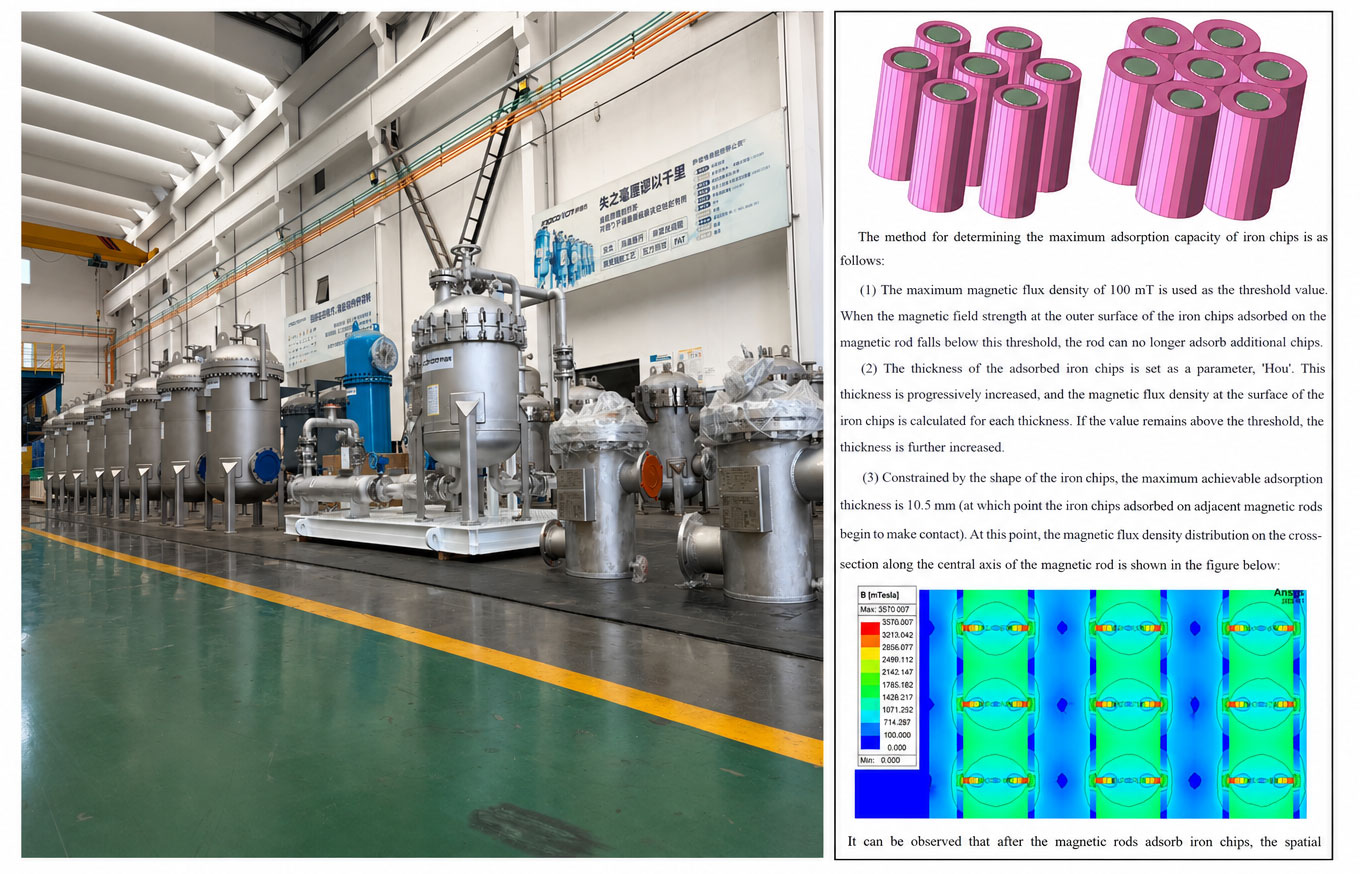
During R&D, Innot systematically optimised the internal flow field and magnetic field distribution of the equipment using fluid simulation. This enables full contact between the fluid and multiple magnetic rods to form high-efficiency magnetic capture zones, greatly improving impurity interception efficiency. Tailored to the specific process conditions of the Lionheart Project, Innot supplied a precisely customised filtration solution to ensure perfect compatibility between the equipment and the new energy production line, and guarantee stable and efficient line operation.
III. Significance of the Cooperation
JordProxa serves as the technology and equipment partner of Vulcan Energy for the Lionheart Project, responsible for supplying core process units for lithium purification, concentration and conversion. As JordProxa’s magnetic filter supplier, Innot leverages profound technical expertise in the new energy sector to successfully enter Europe’s high-end lithium battery material supply chain. This delivery not only demonstrates Innot’s technical strength in magnetic filtration, but also sets a benchmark for Chinese manufacturing participating in Europe’s green new energy construction.



 INOCO Green Energy Solutions Co., Ltd. |